
The Open Housing Service and Operating model now has AI and regulation overlays
Same map, two new lenses: AI and regulation
The open housing operating model now has optional layers. The first two show where AI could help, and which laws and standards sit behind each piece of work.
Last week's post about the open service and operating model was really well received, with over 4.5k impressions, 4 reposts, 52 likes and 23 comments. We've also had the first issue raised on github and i've been contacted directly by people in the sector with their individual work around services which they want me to build into the model (which i will do, just need to carve out some time :).
This is all great news and just the sort of response and collaboration that i hoped my post might generate.
At the end of my last post I promised to do what Rannoch did: go through the model activity by activity and look at where AI is likely to help, and where it isn't.
I did. But halfway through, I changed my mind about where it should live.
Why AI isn't part of the map
The first version of the AI analysis was baked into the model. Every activity had an impact rating and a governance tier sitting alongside its name and code.
It didn't feel right.
The model is meant to be a shared description of what a housing association does. "Triage damp and mould reports" is an activity whether or not you ever use AI for it. Whether AI should help with it is a judgement, and a contestable one. Mixing the two makes the description harder to agree on, and makes the judgement look more settled than it is.
So I made the decision that the core model stays plain. Opinions sit on top of it as layers.
A layer is a point of view about the activities. It has its own version, its own sources and its own caveats. It's checked automatically against the model, so it can't drift out of step. And in the atlas it's off by default. You see the map first, then choose a lens if you want one.
Once I'd built one layer, a second one was obvious.
Layer 1: AI impact and governance
For every one of the 667 activities, the AI layer gives three things.
Impact. Rannoch's five categories: does AI augment a person's work, automate a bounded task, carry out multi-step agentic work, enable someone with knowledge they don't have, or make no material difference?
A governance tier. How careful you'd need to be if you used AI for that activity. It draws on the NHF's AI code of practice and the Regulator of Social Housing's public comments on AI. The more an activity could affect a person, the higher the tier.
- Tier 1 is internal work that doesn't directly affect a resident or colleague, like forecasting or producing board reports. 241 activities.
- Tier 2 is work that uses personal data or supports someone's case, where a person still makes the call. 223 activities.
- Tier 3 is work that decides or communicates something about someone's home, money, safety or rights. 203 activities.
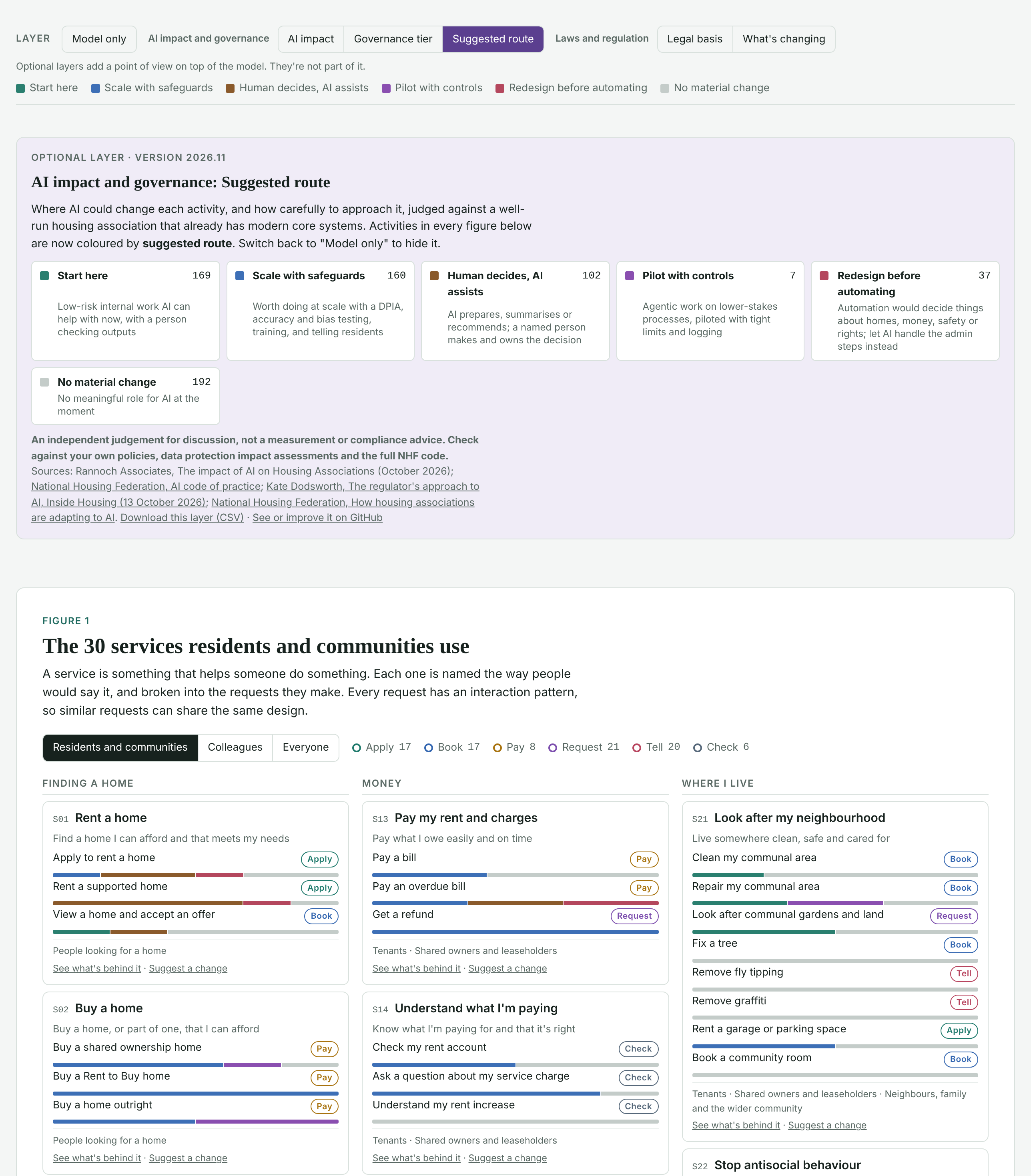
A suggested route. What to actually do about it.
| Route | Activities |
|---|---|
| Start here | 169 |
| Scale with safeguards | 160 |
| Human decides, AI assists | 102 |
| Pilot with controls | 7 |
| Redesign before automating | 37 |
| No material change | 192 |
A few things stood out.
Most of the easy wins are backstage. All 169 "start here" activities are tier 1, internal work: analysing why people contact you, raising void works orders, monitoring contractor performance, producing board and performance reports, forecasting. Low risk, quick to test, and a sensible place to build confidence.
The work residents care most about needs the most care. Triaging damp and mould reports is a good example. AI could genuinely help: spotting patterns in photos, flagging repeat reports, drafting the response. But it's tier 3. Under Awaab's Law it's about someone's safety, with legal timescales attached. So the route is "human decides, AI assists". AI prepares, a named person decides.
37 activities need redesigning before anyone automates them. These are places where automation would end up deciding something about a home, money, safety or rights. That includes escalating arrears cases, serving notices, checking Right to Buy eligibility and calculating complaint compensation. The answer isn't "never use AI here". It's to pull out the admin steps AI can help with, and keep the decision with a person.
192 activities won't change much at all. Inspecting water tanks, clearing empty homes, coordinating support with other agencies. Physical work, and work that stays human. A bit of perspective is healthy.
Layer 2: laws and regulation
When I mentioned the AI layer, a few people asked the same question: what actually requires each piece of work?
So the second layer is a register of 48 laws, regulatory standards and codes that apply to housing associations in England. That's 20 Acts, 10 sets of regulations, 12 standards and 6 codes, from the Regulator's consumer standards and Awaab's Law to the Leasehold and Freehold Reform Act and the Procurement Act.
Each one is linked to the functions and activities it either requires (the activity exists because of it) or shapes (it sets how the work is done). There are 267 links so far.
That gives two lenses.
Legal basis. What's the strongest thing requiring each activity?
| Basis | Activities |
|---|---|
| Required by law | 190 |
| Required by a regulatory standard | 84 |
| Required by a code | 37 |
| No specific requirement | 356 |
More than half the activities aren't required by any specific rule. That's not the same as optional. You can't run a housing association without finance, IT or recruitment. But it's a useful prompt. When someone says "we have to do it this way", it's worth checking whether that's the law,
the regulator, a code, or just habit.
What's changing. When does the next dated change hit each activity?
108 activities are affected by a change in the next 12 months. 54 more are affected in the next one to three years.
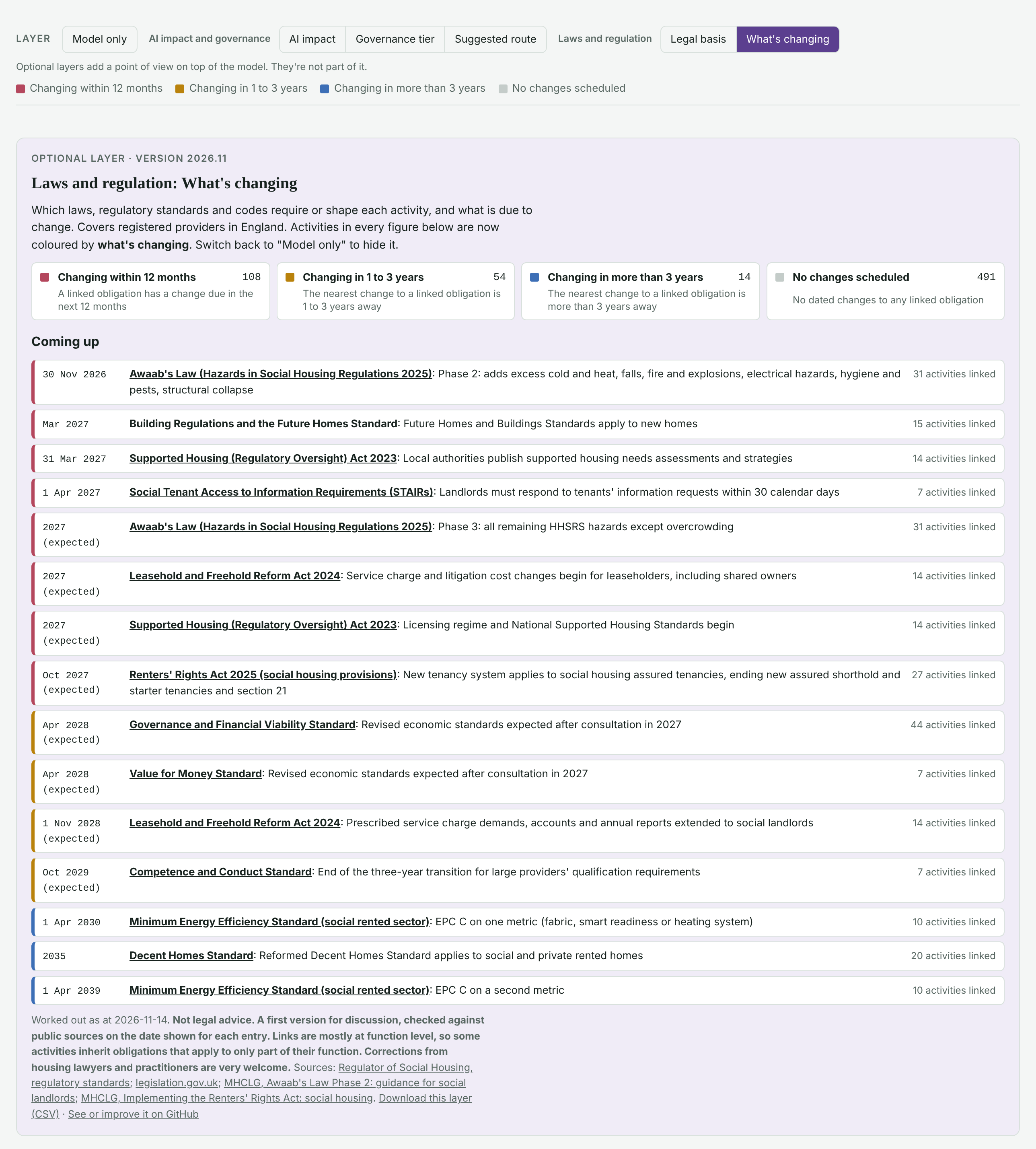
There's also a "Coming up" timeline. The next few entries:
- 30 November 2026: Awaab's Law phase 2 adds more hazards, including excess cold and heat, falls, fire and electrical hazards
- 2027: Awaab's Law phase 3, covering most remaining hazards (expected)
- 1 April 2027: STAIRs. Landlords must respond to tenants' requests for information within 30 calendar days
- October 2027: the Renters' Rights Act's new tenancy system applies to social housing (expected)
- 2030 and 2039: EPC C targets for social rented homes
- 2035: the reformed Decent Homes Standard
Click any activity and you can see exactly which obligations require or shape it.
Put them together
The interesting part is laying one lens over the other.
Of the 190 activities required by law, only 21 are AI "start here" activities. 47 are "human decides". Statutory work is where AI needs the most care. That's not surprising, but it's useful to see it laid out.
And of the 108 activities facing a change in the next year, 44 are tier 3. That's the work where you're already changing processes because the law is changing. It's also where you'd most want to get AI governance right. If you're redesigning damp and mould handling for Awaab's Law phase 2 anyway, that's the moment to decide where AI fits, not after.
Keeping the law up to date
A register of laws is only useful if it's current. I'm not going to remember to check 48 sources every week, and neither is anyone else.
So there's now a regulation watcher. Once a week, a GitHub Action checks the register against GOV.UK and legislation.gov.uk and opens an issue when something might need updating:
- A guidance page has been updated
- An Act or set of regulations has been amended
- A dated change has passed
- An entry hasn't been checked for six months
It also opens a weekly list of new publications from the Regulator, MHCLG and the Building Safety Regulator.
It never changes the register itself. A person reads the source, decides what it means, and makes the change. For something people might rely on, that matters. Picking up one of those issues is a good small way to help.
What these layers aren't
The regulation layer isn't legal advice. It's a map of where the rules sit, for England only. Check the source before you rely on anything.
The AI layer is an opinion. It's judged against a well-run association that already has decent core systems. Yours may be different. It's not a compliance assessment, and it doesn't replace your own data protection impact assessments or the full NHF code.
Both are version one. Both will have gaps.
How you can help
The model itself still needs plenty of help (see last time). For the layers in particular:
- Housing lawyers and compliance specialists. Check the register. Are the obligations right? Are the links to activities right? Is anything missing?
- People using AI in housing. Where have I been too cautious, or not cautious enough? What have you actually tried?
- Anyone with an idea for another layer. Roles and teams. The systems each activity relies on. Tenant Satisfaction Measures linked to the work that drives them. Your costs, if you're brave.
Everything is on GitHub under a Creative Commons licence. Every page in the atlas has a "Suggest a change" link, and there's a five-minute guide if you've never used GitHub.
Try it
Same map, different questions. Tell me what you'd want to look at next.