
Reimagining what a company can be in the AI-era and what technology leaders might need to think about
A couple of weeks ago Jack Dorsey (Block, Ex-Twitter) and Roelof Botha of Sequioa wrote this article:
 amoore
I have a healthy amount of scepticism about tech-bro re-imaginings of the world of work (anyone remember Holocracy, lol), but i gave it a good read and also watched this interview:
 amoore
Fundamentally the proposition is that how organisations are currently designed to deal with managing information flow, and now that AI has developed to a certain level of utility we can fundamentally re-design what an organisation is and what the roles of the humans 'at the edges' actually do.
In this article i'm not going to pass judgement on the validity of the approach, instead i'm going to try and explain it to myself (and maybe you) and think about what the implications might be for tech leaders (CIO/CTO/IT Directors) in hierarchical organisations.
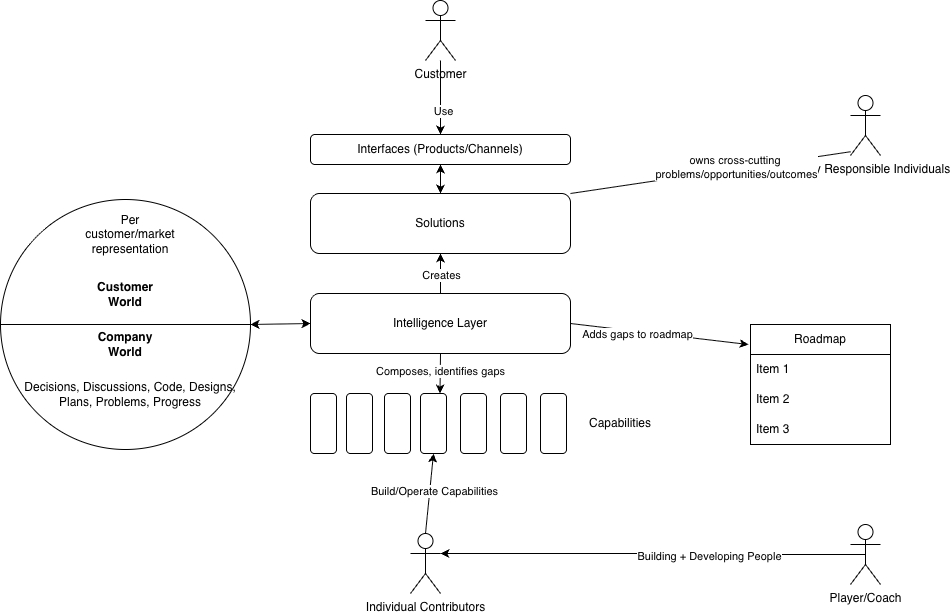
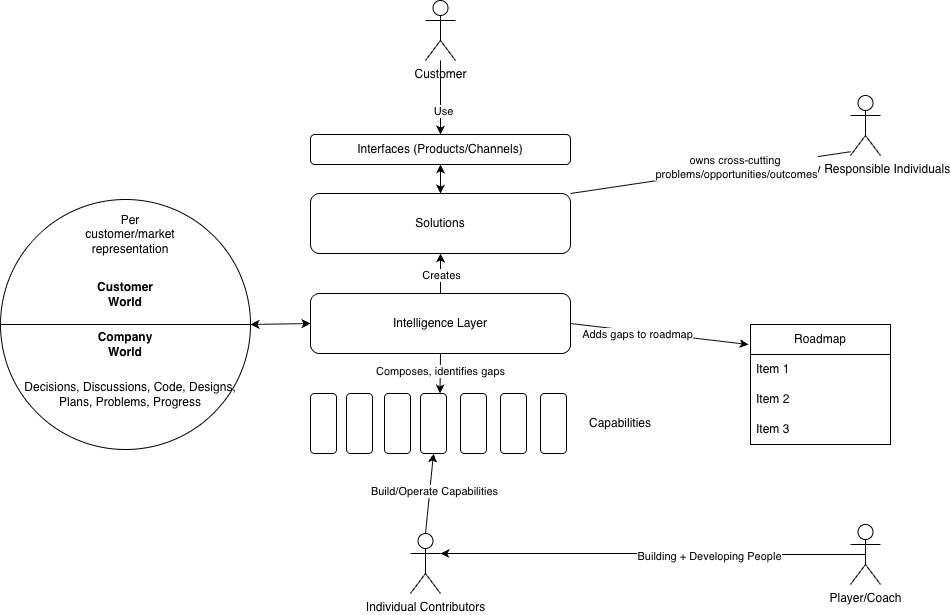
This diagram is my attempt at visualising the new type of organisation that Jack/Roelof propose, and where Jack is taking Block.
The Core Argument: Hierarchy Was Always an Information Problem
The Sequoia article opens with a historical observation, the corporate org chart isn't a management philosophy, it's a communications protocol. From Roman legions to Prussian General Staffs to American railroads, hierarchy emerged as the only available solution to a single constraint: humans can only effectively manage 3–8 people at once. Every layer of management is essentially a relay node passing information up and down.
The articles claim is that AI can now replace what those relay nodes do, which means the entire organisational structure built around them becomes optional.
Key Points from the Interview and Article
1. The company as a "mini-AGI". Dorsey's central idea is to stop thinking of AI as a productivity tool bolted onto existing structure, and instead treat the company itself as an intelligence. Block is remote-first, which means virtually everything, Slack messages, code commits, documents, meeting recordings, already exists as machine-readable artefacts. An AI layer placed over all of that creates a continuously updated "world model" of the company that anyone, from a board member to a new hire, can query directly. The hierarchy was the only way to access that context before. Now it isn't.
2. Three roles replace the org chart. Dorsey wants to collapse all roles into just three:
- ICs (builders/operators) the people doing the actual work, augmented by agents
- DRIs (Directly Responsible Individuals) owners of customer outcomes and cross-cutting problems, with full authority to pull resources
- Player-coaches people who develop others' craft by doing the work themselves, not managing status meetings
The key shift: player-coaches are no longer a reporting structure. They're an assignment. The world model handles alignment. The DRI structure handles priority. The player-coach handles craft.
3. The roadmap as the enemy. One of the most interesting ideas is that the traditional product roadmap, where PMs hypothesise what to build is "any company's ultimate limiting factor." In Dorsey's model, when the intelligence layer tries to compose a solution and can't because a capability doesn't exist, that failure is the roadmap. Customer reality generates the backlog directly, rather than internal opinion.
4. Speed of execution as the proof point. Dorsey described a shift that happened in December 2025 when frontier models became capable of understanding large legacy codebases, not just greenfield prototyping. His teams came back from the holidays surprised by what the tools could do. The result: Block cut 40% of its workforce in under three weeks, structured not as a reactive cost cut but as a proactive rebuild. The test they applied was simple, would we build the company this way if we were starting today?
5. Money as the moat. The article makes a compelling case that this model works especially well for Block because transactions are the "most honest signal in the world." People lie on surveys; they don't lie with their money. Having both sides of the transaction (Square for merchants, Cash App for consumers) creates a compounding data flywheel. The richer the signal, the better the model, and the better the model, the more transactions. I think its interesting to think of how this would transfer to other industries where customer insight are less strong and less black and white?
What Technology Leaders Specifically Need to Be Thinking About
So what does this approach mean for CIOs/CTOs? I think even if going to the Block extreme of cutting 40% of workforce and fundamentally re-designing their operating model for what they see as a new paradigm is nowhere on your radar there are still some useful questions to ask ourselves.
Your existing tech stack and information flow is the raw material, but is it machine-readable? The entire premise of the "company world model" depends on artefacts being accessible and "legible" to AI. For most enterprise IT environments, that's a hard question. Data sits in siloed systems — ServiceNow, Jira, Confluence, Salesforce, email archives — with inconsistent schemas, poor metadata, and no unified access layer. Also a load of really important information (especially in non-remote organisations) will sit between the ears of employees, so theres probably a whole new practice around increasing the ratio of digitised knowledge that most organisations would need to embed.
So there are both ways of working and infrastructural problems to solve long before this becomes an org design problem.
The DRI model shifts authority and that has IAM and governance implications If DRIs are empowered to "pull resources" across teams with full authority for 90-day problem sprints, the traditional IT governance model of role-based access control tied to permanent org positions breaks down. You need dynamic permissions, auditable delegation chains, and governance frameworks that can move at the speed of a DRI's mandate. This is a real systems design challenge that I don't think most enterprise security architectures aren't built for.
AI agents change what "headcount" means for IT planning Dorsey explicitly says one IC augmented by agents can do the work that previously required a team of 10. For IT leaders doing workforce and capacity planning, this invalidates most of the assumptions baked into current models. The question is no longer "how many engineers do we need to deliver X?" but "what capabilities do we need to maintain, and what is the minimal human judgment required to operate them reliably?"
The intelligence layer requires a new kind of platform engineering Block's architecture — capabilities → world model → intelligence layer → interfaces — is essentially a new enterprise architecture paradigm. For Tech leaders, the practical question is what the equivalent is in your domain. What are your "atomic capabilities" (APIs, data services, integrations)? What would a customer or employee world model look like? Who owns the intelligence layer, and how is it governed? These aren't AI strategy questions, they're platform and architecture questions that we as technology leaders needs to own.
Your legacy roadmap process is a liability If Dorsey is right that the roadmap is the limiting factor, then the traditional IT project portfolio management process, quarterly prioritisation cycles, steering committees, multi-year programs, becomes a competitive disadvantage. Tech leaders should be asking whether they can shift toward a capability-first model where the intelligence layer surfaces demand signals, and human judgment focuses on capability gaps rather than feature specs.
The "player-coach" model demands a different kind of tech leader The death of the pure-management role hits IT particularly hard, since the industry has spent decades creating a career ladder that takes strong engineers and eventually makes them full-time managers. Dorsey's model says that's a mistake, player-coaches must stay close to the work. For IT organisations with large management-heavy structures, this is both a talent strategy challenge and a cultural one. The leaders who thrive will be the ones who kept their technical skills current while also developing the coaching muscle.
Let's just assume for now that this model isn't just another silicon valley tech-bro wet-dream and that in the future more organisations will be started adopting this new operating model, and some existing companies will also transition to this new model. I guess the questions for us as CIOs/CTO/etc would be, if it's not a case of whether this is coming but when, how far along our own data and architecture journey are we to enable the new technology architecture to support this new way of operating?